
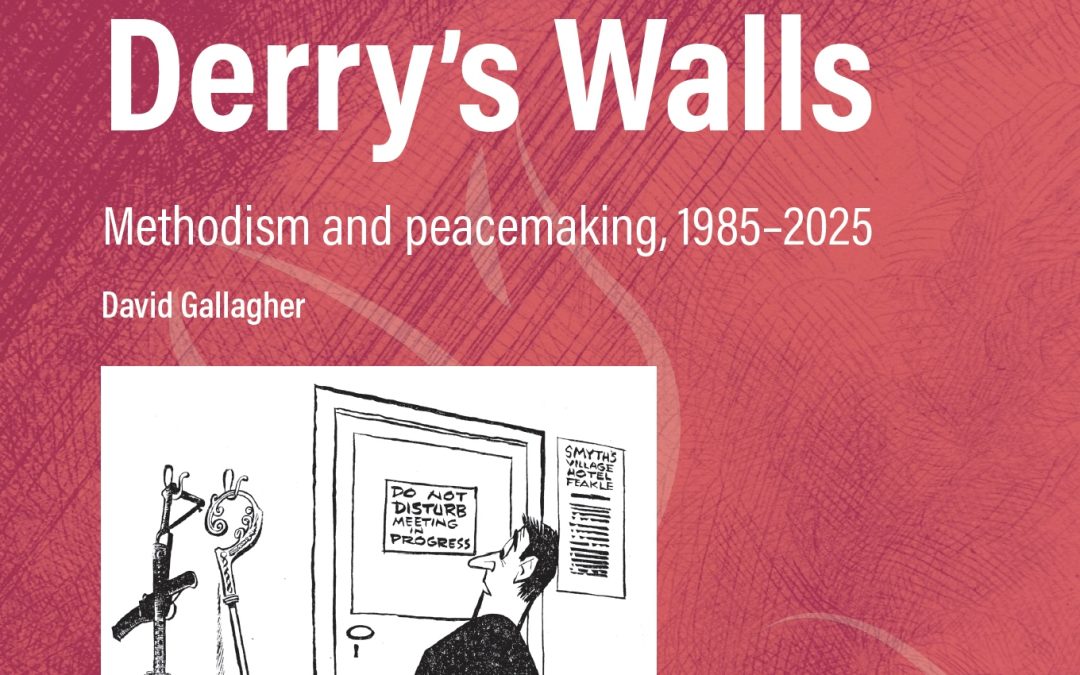
The researcher’s dilemma – breaking confidences or building confidence? My research for my recently self-published book ‘From Feakle to the Falls and Derry’s walls: Methodism and peace-making 1985-2025’ draws on an extensive archive and recollections garnered from fellow Methodist participants, and others. It catalogues and critically assesses the contribution of Methodism over four decades.
At the early proofreading stage, the BBC One reality programme, Traitors, came to its dramatic conclusion. As Claudia Winkelman delivered the punch line of all punch lines: ‘Two Traitors, but totally faithful to each other,” I saw an obvious similarity between the programme and my project: How much of private conversations should be revealed and at what stage? In other words, should “what is said in the tower, stay in the tower”? That is a fundamental dilemma for a programme editor and researcher alike.
Some of the research and subsequent commentary is a re-hash of that which was always in the public domain. Other information has been included to explain the context to Government documents and initiatives now available to public scrutiny. New evidence is provided for the first time. The disclosed archive provides balance, further insight, and perspective of where the Methodists were coming from. In terms of transparency, so far, so good.
There is a potentially serious criticism of the ‘tell-all.’ The criticism surrounds the possible, or actual, breaking of confidences, not just unfair on the unsuspecting and “innocent” individual(s) involved but through publication making it more difficult for such or similar initiatives from taking place in the future. It becomes a question of trust.
Thirty years have passed since most of these meetings took place; such a time lapse can allow for revelation safe in the knowledge that information will do more to illuminate than harm. It is time for the story of so many quiet peacemakers to be told. Furthermore, Government archives in Belfast, Dublin and London have now been opened allowing the public to draw its own conclusion. Opportunities present themselves for journalists and historians alike to review objectively or otherwise. There is an argument, therefore, that there is validity in an overall commentary and context being provided for the sake of discernment by someone who was intimately involved at that time.
As time progresses, memories fade so a record such as this provides factual substance. So much has been written over the years about this period yet the role of the churches remains somewhat vague; this adds a degree of clarity at least as far as the role of the Methodist Church is concerned.
The book will offer such revelations as;
- the first official meeting Gerry Adams had with any Church – two versions of the same NIO document are published, one redacted, the other unredacted; the difference between the two explained.
- responding to a call for help from John Hume and Gerry Adams and then sending a message to Downing St in an attempt to prevent the breakdown of the ceasefire. Several “red box” memos are revealed including what John Major really thought of John Hume.
- meeting Martin McGuinness a fortnight after the Canary Wharf bomb with the full script of what the Methodists said to him.
- meeting the Mitchell Commission on Decommissioning and, in particular, Harold Good’s reply to a question about the possible role of the churches in decommissioning, some ten years in advance of his involvement with Alec Reid as ‘eyewitnesses’.
- a chance conversation with Alistair Campbell leading to a Prime Ministerial soundbite; and the key concept was “trust”!
The Methodists were listeners and interpreters, both at the same time. They were encouragers and challengers; to encourage does not mean to add or lend support or agreement per se, rather it is to affirm the democratic path of dialogue. All were challenged not just with the straightforward “what do you mean?” but rather “what else can you do or give?” Indeed, to associate “with” does not mean acceptance “of” despite the criticism of treason and secret pacts being made. The Methodists were, on a few occasions, facilitators across the spectrum for loyalists, for republicans and for the state. Elsewhere, they were shuttle diplomats but only to the point of “I know you are meeting them so please tell them…” They did not act as back channels as such rather as conduits of impressions and understandings. It also is the case that at no point did these meetings change purpose; they were always about trying to understand the other, never about negotiation.
As Government documents are now released into the public domain, the walls or “towers” of church halls, vestries and manses should now also talk. And in talking, pointers might be offered and lessons might be learnt. TV reality programmes are often exported to other networks but whilst no peace process is ever the same, knowledge of the Methodist modus operandi, whilst only one of many, might help in building confidence elsewhere.
Breaking confidences or providing a template for building confidence? Read and decide!
Book available from: An Ceathru Poili, The Book Well, Evangelical Bookshop, Little Acorns (Londonderry), Secret Bookshelf (Carrickfergus) and Sinn Fein Bookstore. Price £20.00 Contact author: David Gallagher on 07745127267 or by email at davidgallagher904@gmail.com.
Dr David Gallagher was Lay Secretary of the Methodist Church Council on Social Responsibility’s Northern Executive from 1990-2003 and Senior Vice Principal of Methodist College Belfast from 2007-2013.
Please note that the statements and views expressed in this article of those of the author and do not necessarily represent those of Contemporary Christianity.
Thank you David, glad to see CC giving you space here to ‘plug’ and important book.
I am very grateful to David for his excellent article based on his book. What he has recorded is not only a significant record of the process of Methodist engagement towards reconciliation and peace but offers a model which encourages politicians, churches and citizens to engage in respectful listening
and dialogue. It offers the vision of reaching that place where ‘hope and history rhyme’ in
communities of justice and mutual understanding.
I am very grateful to David for his excellent article based on the book he has written. It is not only
important as a public record of the involvement of Methodists in in seeking reconciliation and peace but offers a template for continuing engagement.
Respectful listening and a desire to understand each other is a significant part of what David calls ‘the democratic path of dialogue’. David’s writing reveals the importance of crossing the boundary of difference to interpret to each other how we might build together a new community of trust. Jonathan Sacks, a former Chief Rabbi, spoke of ‘violence as a failure in concersation’. In writing the story of Methodist engagement in many conversations over forty years he reveals what is possible,now and in the future, when we cross the boundaries – to listen and talk to each other.
Excellent coherent piece of writing and research by my colleague David Gallagher, containing so many lessons of how quiet under the radar peace building by religious actors contributed to eventual peace. It underlines the slow work of relationship building and creating a moral framework that can make a difference in the long term.