
I have a friend who always reads the last page of a book first. She needs to know how the story ends before investing the time in reading it. My 91-year-old mother and I have the same conversation every Eastertide when she recalls the early years of her working life. She would come home to Galway from Dublin on Maundy Thursday evening and she was ready for the Easter celebrations. She knew the happy ending to the story and struggled to go through the sadness and reflective silence of Good Friday and the strange waiting of Easter Saturday.
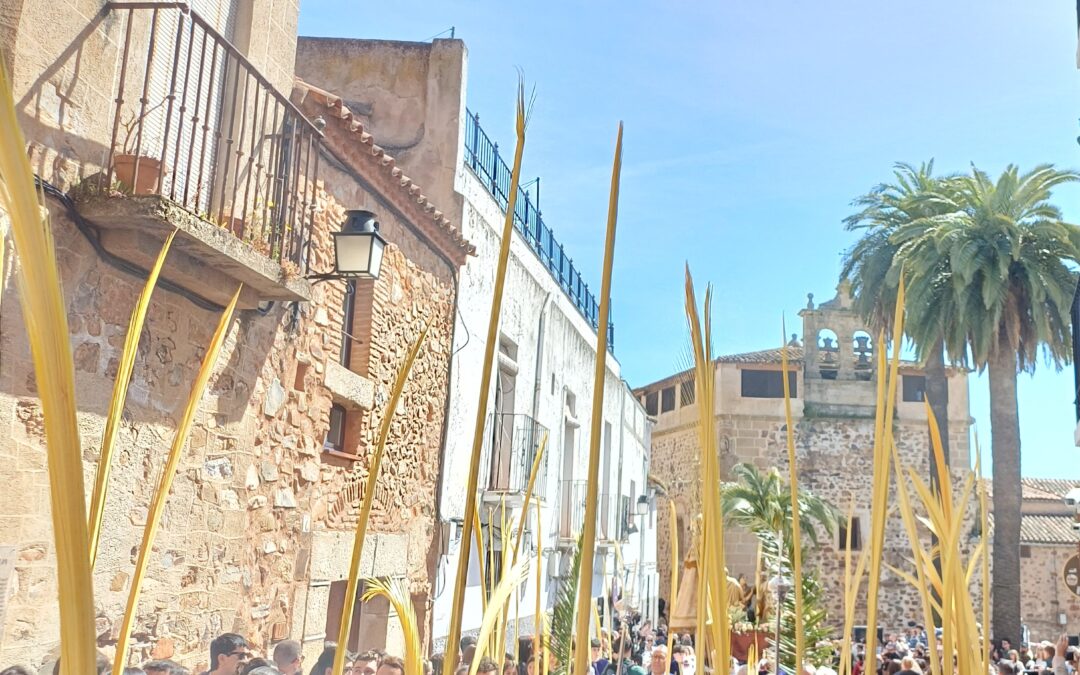
This year I spent Holy Week visiting my daughter in Cáceres, a medieval hill town in the western reaches of Spain. They have so many processions to honour each part of Semana Santa that they have created an App, with the names, timings, and route of each procession. On Palm Sunday the icon on the App showing the live progress of the procession was a little donkey. Two local friends had told my daughter their favourite place to stand, so we claimed a spot well in advance, with the smug feeling of having an advantage over the other tourists. For almost an hour, people passed us with long fronds of palm and olive branches. They all seemed to be going in one direction and none of the locals were stopping where we stood. We panicked – perhaps we had it wrong? Perhaps this was the best spot for a different procession, on a different day? What were we missing? We caved in to our doubts and followed some palm fronds through the twisty cobbled streets, feeling the excitement building with the crowds, joining families of all ages, groups of teenagers and elderly couples. In the distance we heard a drumbeat, and my daughter looked at the App, declaring ‘the donkey is moving’! We claimed a new spot looking down the street, a tall palm tree and the ancient stone walls evoking the streets of Jerusalem and felt the wave of excitement building with the sound of the drums. Small children held on to their palm fronds, waiting eagerly for the opportunity to wave them.
I have always wondered how did those Jerusalemites and Passover pilgrims know that the Rabbi who was coming into town on a donkey was the Messiah? On Palm Sunday I realised that the build-up would have been just the same. Pilgrims and locals are milling around in general expectation of the Passover celebrations to come. A feeling of anticipation passes from one to another, people move, others follow and a crowd builds. Lo and behold, when Jesus turns the corner, they recognise Him for who He is, the humble king, riding a donkey, bringing salvation and they shout; “Blessed is the King who comes in the name of the Lord! Peace in heaven and glory in the highest!” (Luke 19:38).
They are quoting Psalm 118 which goes on to say in verse 27; “The Lord is God, and he has made his light shine on us. With boughs in hand, join the festal procession up to the horns of the altar.” They recognise Jesus as King because he is fulfilling the prophecy in Zechariah 9:9, as outlined in Matthew 21:1-5; “This took place to fulfil what was spoken by the prophet, saying, ‘Say to the daughter of Zion, Behold, your king is coming to you, humble, and mounted on a donkey, on a colt, the foal of a donkey.’”
Of course, not everyone realises in the moment, the full significance of Jesus’ arrival. As we read in John 12:16, “At first his disciples did not understand all this. Only after Jesus was glorified did they realise that these things had been written about him and these things had been done to him.”
So maybe there is something to be said for knowing the end of the story before you begin! The whole experience was a good reminder for me that we are waiting again, for Jesus to return. We have been told the end of the story, but like the virgins with their lamps or the householder anticipating the thief in the night, we do not know when He will come. There is no App to tell us when He is on the move. We can only wait in joyful anticipation of the blessing; “Stay dressed for action and keep your lamps burning… Blessed are those servants whom the master finds awake when he comes.” (Luke 12:35–37).
Sharon Crooks lives in London and works as a mediator, conflict coach, and trainer. She is a trustee of WMS, a community mediation service, and is passionate about helping people to communicate better to create peace in all its fullness.
Please note that the statements and views expressed in this article are those of the author and do not necessarily represent those of Contemporary Christianity.
Recent Comments