
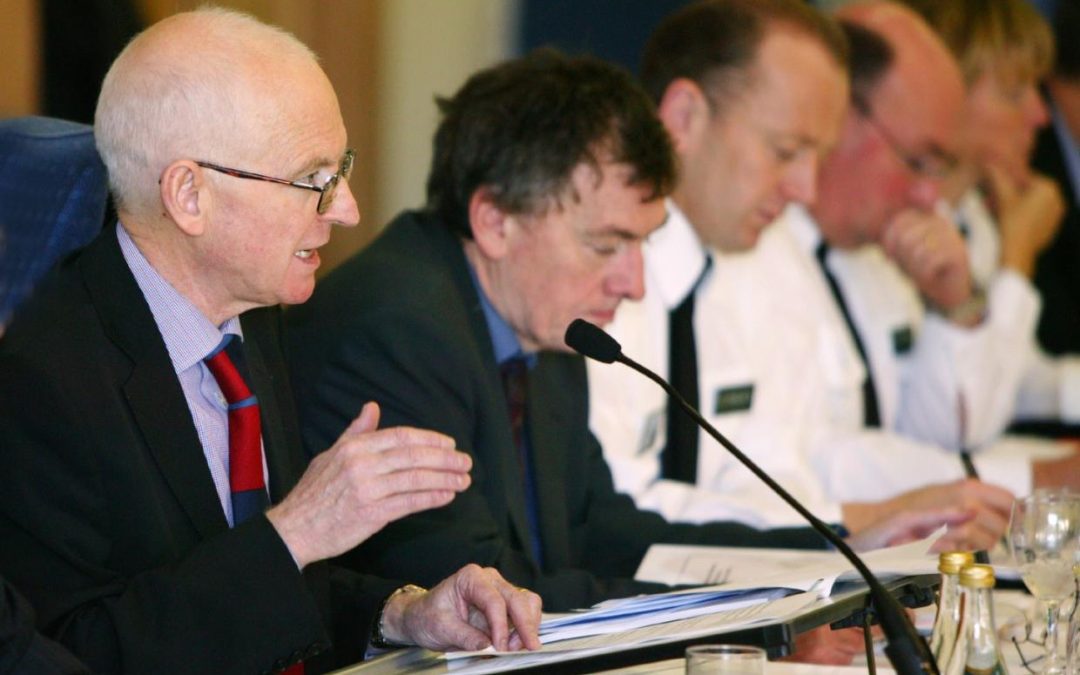
The recent passing of Professor Sir Desmond Rea brought for me a sharper focus on what we mean in Northern Ireland by the term “a practising Christian.” Sir Desmond’s contribution to civic life in Northern Ireland was by any standard remarkable. This has been the subject of many public tributes but as instructive as they are, it was another aspect of his life which always intrigued me and which I seek to expand below.
Throughout his entire life Sir Desmond was informed and animated by his Christian faith. Nothing particularly unusual there, you may reply. So many in Northern Ireland would seek to say the same thing. Many have also made significant contributions. Why is this any different? What struck me was Desmond Rea’s insistence that Christianity must be…” practical and not theoretical.” Loving your enemy meant being prepared to speak and reach out to those who had inflicted enormous pain and suffering on an entire community. Forgiveness required concrete action not a quiescent or passive approach. In Desmond Rea’s case he invested himself wholly in dialogue and built a network of relationships across all divides with the clear aim of promoting understanding. Nowhere was it better demonstrated than in his chairing of the Northern Ireland Policing Board, which required according to one friend “ the patience of Job and the wisdom of Solomon” Somehow in tandem with Denis Bradley the foundations were laid for a new beginning to one of our most contentious problems.
Such a disposition has of course also been demonstrated by some extraordinary individuals such as Gordon Wilson whose words after the murder of his beloved daughter Marie in the Enniskillen bomb still resonate…“I have lost my daughter, and we shall miss her. But I bear no ill will. I bear no grudge. … That will not bring her back. … I shall pray for those people tonight and every night. May God forgive them.”
Historian Jonathan Bardon recounts, “No words in more than twenty-five years of violence in Northern Ireland had such a powerful, emotional impact.”
Both Rea and Wilson were Methodists a Christian community that has contributed well beyond its modest number of adherents in Ireland. What is brought out in David Gallagher’s comprehensive account of “Methodism and Peace-making- From Feakle to the Falls and Derry’s Walls” is the practical application of the gospel injunction to seek forgiveness and grace even in the darkest of days.
Is it unfair to question whether in Northern Ireland terms we have majored on theoretical as opposed to practical Christianity? Christians need the safety of the credal walls. Doctrine is important, oftentimes critically so, but alongside our necessary theology lurks hidden traps for the unwary, which can poison our relationships and lead us into a different kind of error.
The recent trouble in Belfast is a case in point. Governments have a duty to address the challenges presented by immigration, but Christians have an even greater responsibility, in season and out of season, to preach and to seek to live the gospel of grace and to uphold the dignity of all. The scriptures are also clear about the duty we owe to the stranger. The fear experienced by foreign nationals last week shamed us as a society. Once again, our response needs to be practical and active. Every kind word every welcoming smile every gesture of love can bring hope and dispel fear. The need of the hour is to stand in solidarity with those who have come from abroad to be with us, not to simply wish them away or think that deportation is a panacea.
St John Henry Newman also wonderfully describes God’s calling on our life. He tells us that our divine Master has assigned a specific task to each one of us, a “definite service”, committed uniquely to every single person: “I have my mission”, he wrote, “I am a link in a chain, a bond of connexion between persons. He has not created me for naught. I shall do good, I shall do his work; I shall be an angel of peace, a preacher of truth in my own place …” (Meditations and Devotions, 301-2).
Sound doctrine provides the framework. Dogma is crucial whatever post-modernists may claim but congratulating ourselves on the purity of our theology if not characterised by love strikes a discordant note. The admonition of the Epistle of James rings out with a new clarity:
What does it profit, my brothers and sisters, if someone says he has faith but has no deeds? Can such faith save him? Suppose a brother or sister is without clothes and daily food. If one of you says to them, “Go in peace, keep warm and well fed,” but does nothing about their physical needs, what good is it? In the same way, faith by itself if it is not accompanied by action, is dead.
Rev Deacon Brett Lockhart, St Brigid’s Parish, Belfast.
Please note that the statements and views expressed in this article are those of the author and do not necessarily represent those of Contemporary Christianity.
Brett,
Thank you so much for your article about Desmond. With others I worked with him on The Methodist Council on Social Responsibility. He had an incisive mind, a passion for human rights,
a ready willingness to welcome the stranger and a great desire for justice,peace and reconciliation. These values were based on his Christian faith lived out in living and loving action.
His legacy should move us to cross every boundary which divides whether it is the colour of our skin, gender, sexuality, faith tradition or political expression. As Christians there are journeys we must take urgently to show welcome and affirmation in the welcoming grace of God in order that the shame actions of these last says shall not be repeated. John Wesley wrote ‘A Letter to a Roman Catholic’ in Dublin in 1749. In it he wrote- ‘ We may not as yet in all things think alike but may we not love alike. If your heart is as my heart give me your hand’. This spirit needs to reach across not only faith traditions but across any barrier that holds back a society from being at peace with itself
Brett,
Thank you for this warm and challenging piece – you are quite right that we must hold together sound doctrine and compassionate action – even when both may be costly. Desmond was gifted yet humble brother, there are many of us who will miss him.
David