
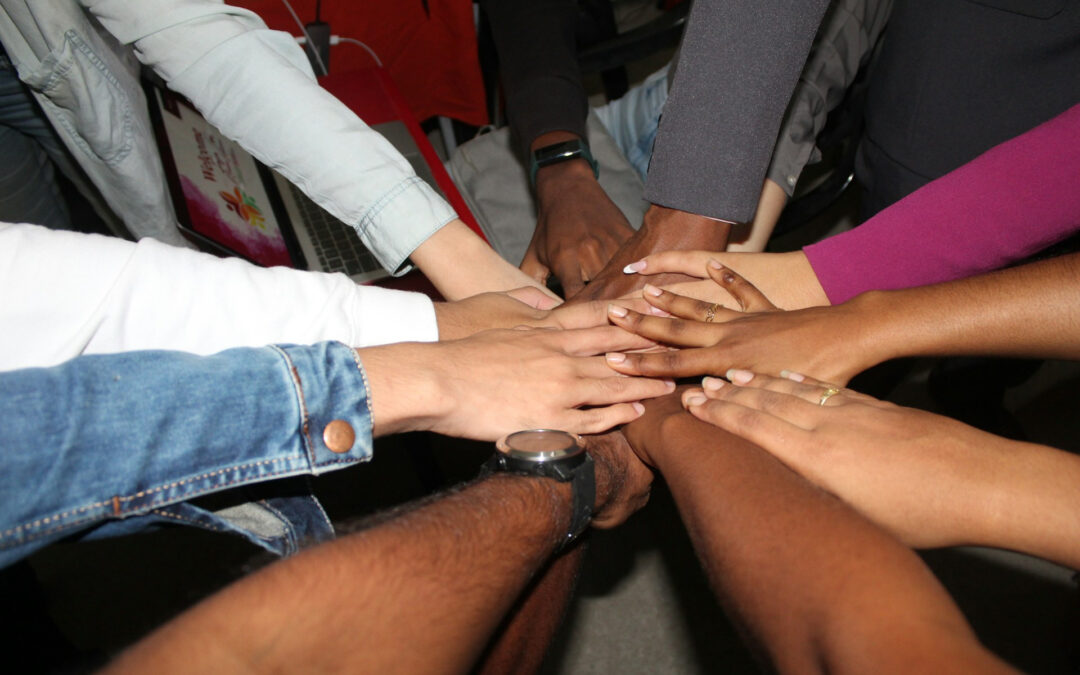
Racial Justice Sunday: 8th February 2026
Racial Justice Sunday challenges Christians to consider their contribution to creating communities, where people from minority-ethnic backgrounds can feel a sense of belonging.
Following relative isolation during the Troubles, people from other countries began to arrive in Northern Ireland to seek asylum, or to fill job vacancies and skills shortages. This was a shock to people who already regarded ‘outsiders’ with suspicion.
The inter-denominational EMBRACE NI group was founded in 2003, to assist churches in becoming more welcoming towards refugees by conveying information and sharing theology and practice of how Christians should welcome.
Our predominant theology was that of ‘welcoming the stranger.’ Our first chairperson, Richard Kerr, described how God was committed to oppressed people in his liberation of the Israelites, and how their relationship with the land was linked to their obedience.
Indeed, the way in which the stranger, together with the widow and the orphan, is treated, is an indicator of the Israelite’s obedience to the law of God and it is this commitment to justice and the defence of the weak that the prophets highlight repeatedly.[1]
Richard explained how Jesus epitomised hospitality in his welcome and treatment of those on the fringes of society. But is more than a welcome. His hospitality was about reconciliation and the transformation from stranger to guest and from guest to friend.
In our work to bring understanding about refugees, or the mistreatment of migrant workers, however, there was a danger of creating relationships of imbalance. We talked about the gifts that people brought into our communities, but the questions always seemed to be about how to help people.
This fear of imbalance seemed justified. Times have changed, but not enough, since the 2005 CMS Ireland short report about the experience of minority-ethnic people. They spoke of widespread racism, and, although some had found welcome, there was a feeling that their gifts were not respected and in church that they were nothing more than ‘pew warmers.’
Many perceived that they were viewed as ignorant and lacked competence. They felt that people were suspicious of them and did not trust them with responsibility, even in the local church.[2]
The use of the words ‘welcoming the stranger’ may not be the best long-term resource for helping people to feel at home amongst us. In the USA, Professor of Religion, Jeremy Rehwaldt talks about reframing our theological thinking because it is unhelpful to use language which identifies newcomers as “strangers,” as “one of them.[3]
How might we reframe our theological inspiration? Churches Together in Britain and Ireland resources for Racial Justice Sunday this year focus around love of neighbour (Mark 12:28-31) … words that are much more inclusive.[4] The Good Samaritan (Luke 10:25-37) is the parable chosen as the sermon theme. Often people read this story as a representation of God’s love, rather than seeing the personal challenge it presents. I surprised one group by suggesting that Jews listening to Jesus, knew very well that they should help those who were vulnerable, but would have been shocked that he made a despised Samaritan the hero.
We must love people despite our preconceptions. Prevailing culture wars should become irrelevant to our attitudes towards people living alongside us. We are left with the difficulties of getting over our prejudices and finding out how to put Christian love into practice.
In response to racist intimidation and attacks we need to support people as well as countering negative stereotyping. We need to be willing to challenge the subtle words of negativity that lead on to louder voices of hate and acts of injustice.
When EMBRACE began, it was a relatively isolated initiative. Things have changed in the past 20 years. We have increasing numbers of schools of sanctuary, where the development of empathy for refugees can lead to young people having a greater respect for everyone around them. And, in addition to denominational and congregational responses, churches have access to organisations with additional expertise, such as Welcome Churches supporting churches in welcoming refugees,[5] and Acacia Path who assist in the welcome of newcomers ‘as image-bearers of God.’[6]
In the Racial Justice Sunday resources for this Sunday Dr Maithrie White concludes her sermon with the reminder that the whole law is fulfilled in keeping this one commandment,
Love your neighbour as yourself. [7]
Services:
- St Anne’s Cathedral will host a “Love your Neighbour” service for Racial Justice Sunday on February 8th at 3:30pm
- St. Peter’s Cathedral will host a 4 Corners event … The Journey Towards Reconciliation…Racial Justice Sunday on February 8th at 7:00pm
References:
[1] Lion and lamb: racism and religious liberty, Autumn 2004.
[2] David Maganda and Rev Canon Rajkumar Sathayraj, Ethic Minorities Report, CMS Ireland 2005.
[3] ‘Jeremy Rewalhdt, Welcoming the Stranger? Rethinking our language of hospitality’ in Journal of Lutheran Ethics, December 2019/ January 2020, Volume 19 Issue 6, https://learn.elca.org/jle/welcoming-the-stranger-rethinking-our-language-of-hospitality/
[4] https://ctbi.org.uk/resources/racial-justice-sunday-8-february-2026/
[5] https://welcomechurches.org/northernireland
[6] https://www.acaciapath.com
[7] https://ctbi.org.uk/wp-content/uploads/2026/01/RJS-2026-Sermon-Revd-Dr-Maithrie-White.pdf
Margaret McNulty is a member of the Church of Ireland and volunteered as information officer for the EMBRACE NI (https://www.embraceni.org) for many years.
Please note that the statements and views expressed in this article of those of the author and do not necessarily represent those of Contemporary Christianity.
Recent Comments