
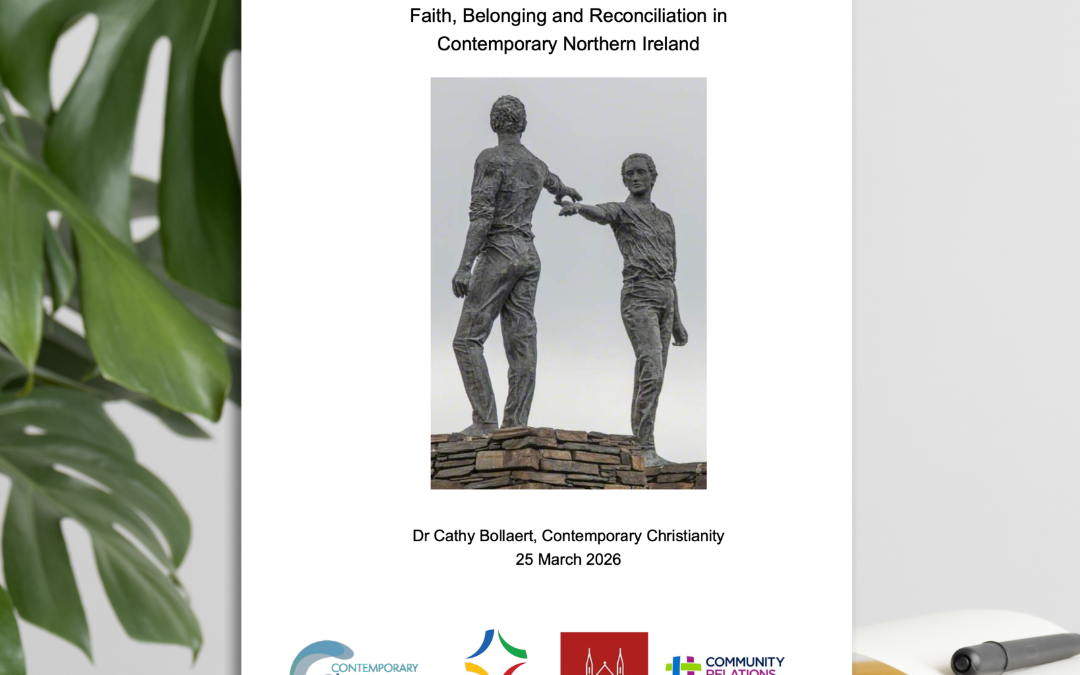
On Wednesday 25th March we launched our report “Faith, Belonging and Reconciliation in Contemporary Northern Ireland”. There was lots of buzz and conversations with sixty people who participated in an engaging evening. Cathy Bollaert, Jamie Plant and Ed Peterson shared the findings and insights from the study, which suggest that while commitment to reconciliation remains strong, current approaches can feel fragmented, unclear, or disconnected from lived experience. Lynda Gould responded to the findings in the report, and the question… Are We Willing to Shift? Here is a summary of her response.
The launch of Contemporary Christianity’s scoping study ‘Rethinking Community Relations and Reconciliation’ proposed commendable but ambitious paradigm shifts needed to bring change.
The five shifts call for a fundamental re-orientation of reconciliation work away from short term, project driven outputs toward long term, relationship centred cultural change. Reconciliation is reframed as inseparable from contemporary justice issues – racism, inequality, migration, and community safety – requiring engagement with structural injustice rather than treating sectarianism as a legacy problem alone.
The later shifts press for deeper belonging beyond hospitality, insisting on safety, dignity, fairness, and equal voice, especially for those most at risk. They also confront participation fatigue and the limits of dialogue without change, arguing that meaningful decisions, visible outcomes, and sustained learning depend on a decisive shift from short term external funding to long term internal investment in relational work.
Bringing these shifts about in Northern Ireland is difficult precisely because they ask us to disrupt what has become familiar and manageable. For decades, reconciliation has been shaped by short term projects, careful language, and external funding that allowed engagement without deep institutional risk. These shifts, instead, demand honesty about the gap between what faith communities say and how they live; courage to confront contemporary injustices alongside legacy divisions, and a willingness to move from welcome to real belonging, where power, voice, and safety are unevenly shared. They also expose the weariness caused by dialogue without change and the uncomfortable truth that long term relational work requires internal commitment, not just external grants. In a context marked by history, habit, and caution, these shifts are hard because they require letting go of control, redistributing resources, and choosing integrity over convenience.
One sentence in the Executive Summary (p.3) sums it up …
“The study suggests that reconciliation work is not failing because of lack of commitment, but because of structural misalignment.”
Herein lies the real challenge.
Over the course of the Troubles and beyond, the religious landscape in Northern Ireland has been reshaped by global forces that have distracted faith from its deeper social and moral purposes. The weight of external pressures often compels systems to adapt, sometimes at the expense of stability or long‑term vision and may explain why reconciliation has often remained marginal rather than central.
Drawing on four critical perspectives, a common pattern emerges. In a culture of constant distraction, faith competes with speed, entertainment, and convenience, becoming something, people dip into rather than commit to. Reconciliation, demanding patience and shared responsibility, is reduced to an optional programme rather than a way of life.
At the same time, the pressure for religion to be engaging and appealing can turn faith into performance, where depth, justice, and healing give way to holding people’s attention. External political and cultural pressures further mute religion’s prophetic voice, encouraging caution over courage and silence over challenge. Finally, faith risks becoming a source of comfort rather than transformation, offering personal reassurance while avoiding hard conversations about inequality, division, and reconciliation.
Together, these dynamics make paradigm shifts especially difficult. Yet, as theologian Matthew Fox reminds us…
“When existing systems no longer work, the conditions for change are created. If faith communities are willing to risk disruption, a new and hopeful paradigm may yet emerge.”
Lynda Gould has a background in youth work, and in peace and reconciliation, helping build understanding across divides. Lynda’s experience in the charity sector has shaped a strong commitment to churches, community and the common good.
We would encourage you to access the report or the shortened version. Both are accessible on our website at https://contemporarychristianity.net/rethinking-community-relations/. We would also love to have feedback and ideas from you as we take this forward. Please contact us at info@contemporarychristianity.net
Easter Greetings to all our PS readers.
Recent Comments